
Yoga For Beginners: What To Expect From Your First Class
My very first yoga class was a Kundalini class at a gym in London. This was pre-mainstream social media, so I arrived knowing almost nothing about yoga. What I got was the full experience: chanting, kriyas, poses I had no business being in. Nobody asked if I was new, nobody offered modifications. And at one point the teacher physically pushed me deeper into a pose and told me that at my age, my knees should be able to reach the mat in a cross-legged seat.I didn't go back. For the next four years, I assumed that was yoga, and that yoga was not for me.
It took a colleague dragging me along to a Vinyasa class to change that. I loved it immediately, and the rest, as they say, is history. But I think about that first class a lot, especially now that I teach. Because I know I'm not the only one who nearly didn't come back. And I know that the reason people don't return usually has nothing to do with yoga itself.
This is the guide I wish I'd had.
What yoga class is best for beginners
If your first class put you off yoga, there's a reasonable chance you were just in the wrong room. The range of styles available now is enormous: from traditional practices like Hatha, Ashtanga, and Iyengar, to modern variations like Vinyasa, Yin, and Rocket, to post-modern ones like yogalates, functional yoga, and the list goes on. They are not the same experience.
So before you book, it's worth thinking about what you're actually looking for.
The most straightforward route into yoga is a dedicated beginner's course. Three or four classes that walk you through the foundational poses, alignment principles, vocabulary, and the general shape of a class. If that's available to you, start there.
If beginner classes aren't available near you, or you'd rather jump straight in, start with Hatha. It's moderate-paced, which means you have time to actually settle into each pose and feel what it's doing rather than rushing to keep up. A good Hatha class will also include philosophy, pranayama, and meditation, so you get a sense of yoga as a complete practice, not just a physical workout.
From there, my advice is to experiment. Try classes that sound appealing, different styles, different teachers. What you're looking for is the class that makes you want to come back, and you won't know what that is until you've tried a few.
What makes a good yoga class
This is personal, what I look for in a class is not necessarily what you're looking for. But beyond the subjective experience of "feeling good" afterwards, which varies enormously from person to person, there are some markers that consistently separate a good class from a great one. These are the things worth paying attention to, especially when you're new.
An approachable and present teacher
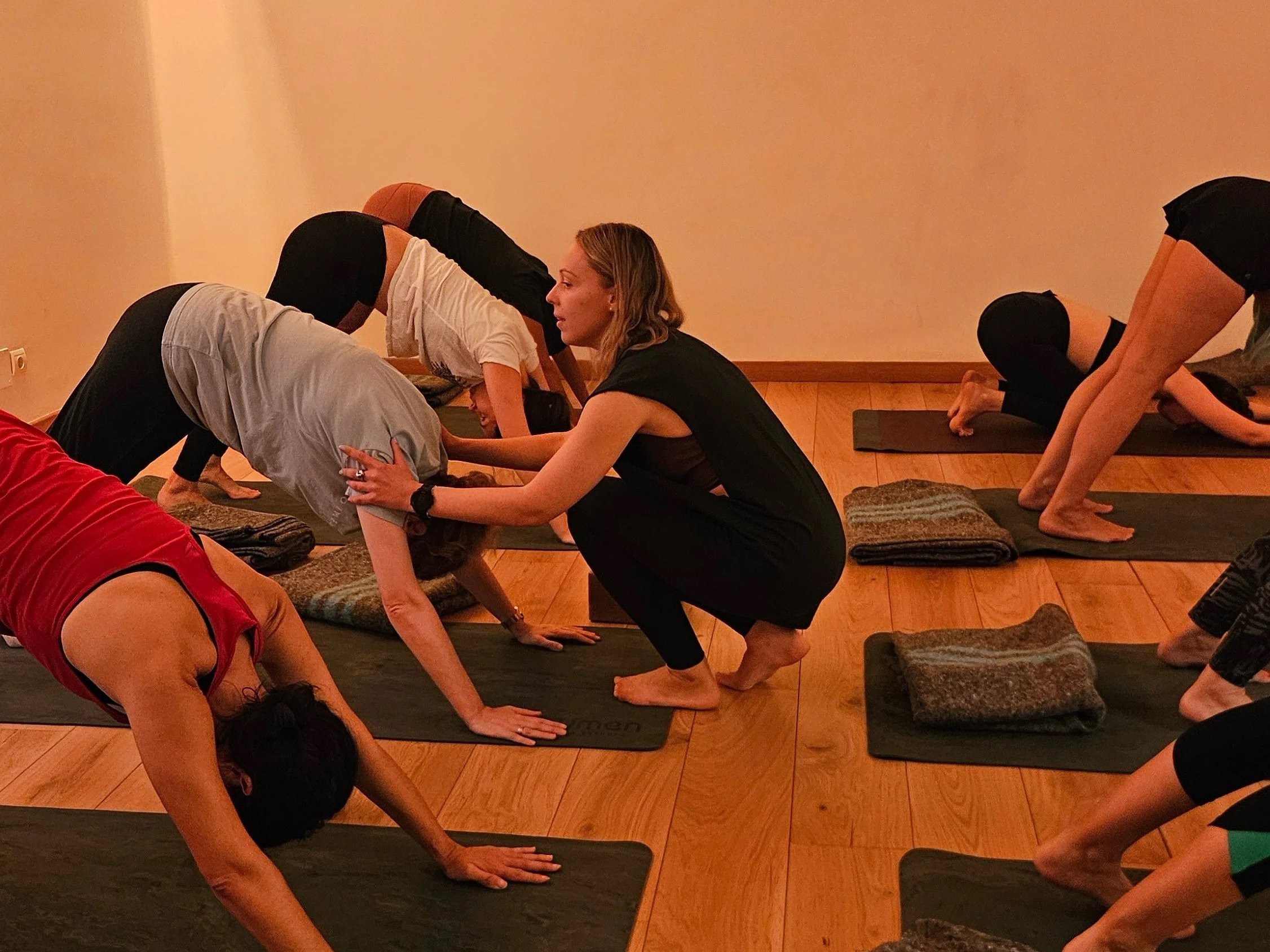
A good teacher greets you when you walk in. They ask about injuries, discomforts, and how you're feeling before class starts. The best teachers don't simply execute a pre-planned sequence regardless of who's in the room. They see you, they adapt, and they make you feel like your presence in the class matters.
The option to opt in or out of hands-on adjustments
I personally love being adjusted, a good hands-on cue can change how you understand a pose entirely. But not everyone does; what matters is that you're given the choice. Watch out for teachers who adjust without asking, or whose adjustments feel abrupt or forceful. You should always feel safer in a pose after an adjustment, not worse.
Options within poses
A teacher cannot realistically offer three variations of every pose in a sixty-minute class. But the best teachers regularly remind you that you have choices: that child's pose is always available instead of another vinyasa, that a modified side plank is not a lesser version of the full pose.
A class that goes beyond the physical
Yoga is not a fitness class. The ones that stay with you, the ones that make you think "that felt like something" on the way home, almost always include pranayama, moments of stillness, and some space for inward attention. It doesn't need to be elaborate. Even two minutes of pranayama and five minutes of lying in silence at the end changes the entire quality of the experience.
What happens in a typical yoga class
A typical hour-long class usually opens with a short introduction - a concept or intention the teacher invites you to carry through the practice. From there, you'll likely settle into a grounding position, seated, lying down, or in child's pose, and begin breathing more purposefully, sometimes moving into Ujjayi pranayama before the body starts to move.
The asana practice that follows usually builds gradually: a warm-up sequence, sun salutations, a wave or two of standing poses, then a cool-down that brings you toward the floor and eventually into savasana, the final pose that closes almost every class. A well-rounded class will weave pranayama and meditation alongside the movement.
My honest advice is to arrive with an open mind, and to try to keep it open even if the class doesn't unfold the way you expected. After completing my teacher training, I went through a phase where any class taught differently from how I'd been trained felt wrong, and I'd spend the hour irritated rather than actually present. Once I let that go and allowed myself to simply move, breathe, and occasionally have fun, I rediscovered the joy of taking yoga classes.
What to bring and what to wear
You don't need special clothing or a fancy yoga mat to join a class. Choose something that gives you freedom of movement and lets your skin breathe. Yoga is practiced barefoot, so no need to worry about footwear beyond getting yourself through the door. Most studios offer mats to borrow for free or for a small fee if you don't have your own. Bring water, a small towel if your hands tend to get damp.
Is yoga uncomfortable for beginners
There are a few kinds of discomfort that might show up on the mat, and all of them are worth knowing about in advance.
The first is physical. Your body may feel stiffer than you expected, and some poses might feel partially or completely inaccessible. If the teacher doesn't offer a modification, feel free to ask, either quietly as they pass during class, or afterwards. A good teacher will always want to know and help you find the best alternative.
Try not to look around the room at other students. I know it's tempting, but it rarely helps. You'll either compare your practice to theirs, compare your body to theirs, or unconsciously copy their mistakes. Your body is unique and this is an individual practice; what's happening on someone else's mat is genuinely none of your business.
The second kind of discomfort is stillness. For some people, meditation and savasana are the best part of class. For others, especially those coming to yoga from a busy, high-output life, lying still with nothing to do can feel deeply uncomfortable, even anxiety-inducing. If that's you, anchor your attention on your breath, count each inhale and exhale and give your mind something concrete to hold onto.
And finally, don't be alarmed if unexpected emotions surface during class, particularly in savasana. It happens more often than you'd think, and it's not something going wrong. Sometimes the body releases what the mind has been holding.
Should you tell the teacher it's your first class
Yes, always. Knowing you're new gives a good teacher something to work with. They'll remember to offer more options, check in on your alignment to help you avoid injury, and give a little more context to poses, pranayamas, or practices that regulars know by heart.
It also tells you something useful about the teacher. The response you get when you say "this is my first class" is one of the clearest signals of whether you're in the right room. A teacher who welcomes that information and adjusts accordingly is one worth returning to. A teacher who pushes you into poses too deep and tells you your body should be doing something it isn't - well, you already know how that story ends.
Remember, every experienced yoga student and teacher you've ever met was once exactly where you are now: uncertain, possibly self-conscious, and not entirely sure what they were walking into.
Want to practice yoga in English in Madrid? Join me for a beginner-friendly flow, you can find my current schedule here.